Serving West Des Moines, IA and surrounding areas. (515) 706-9183
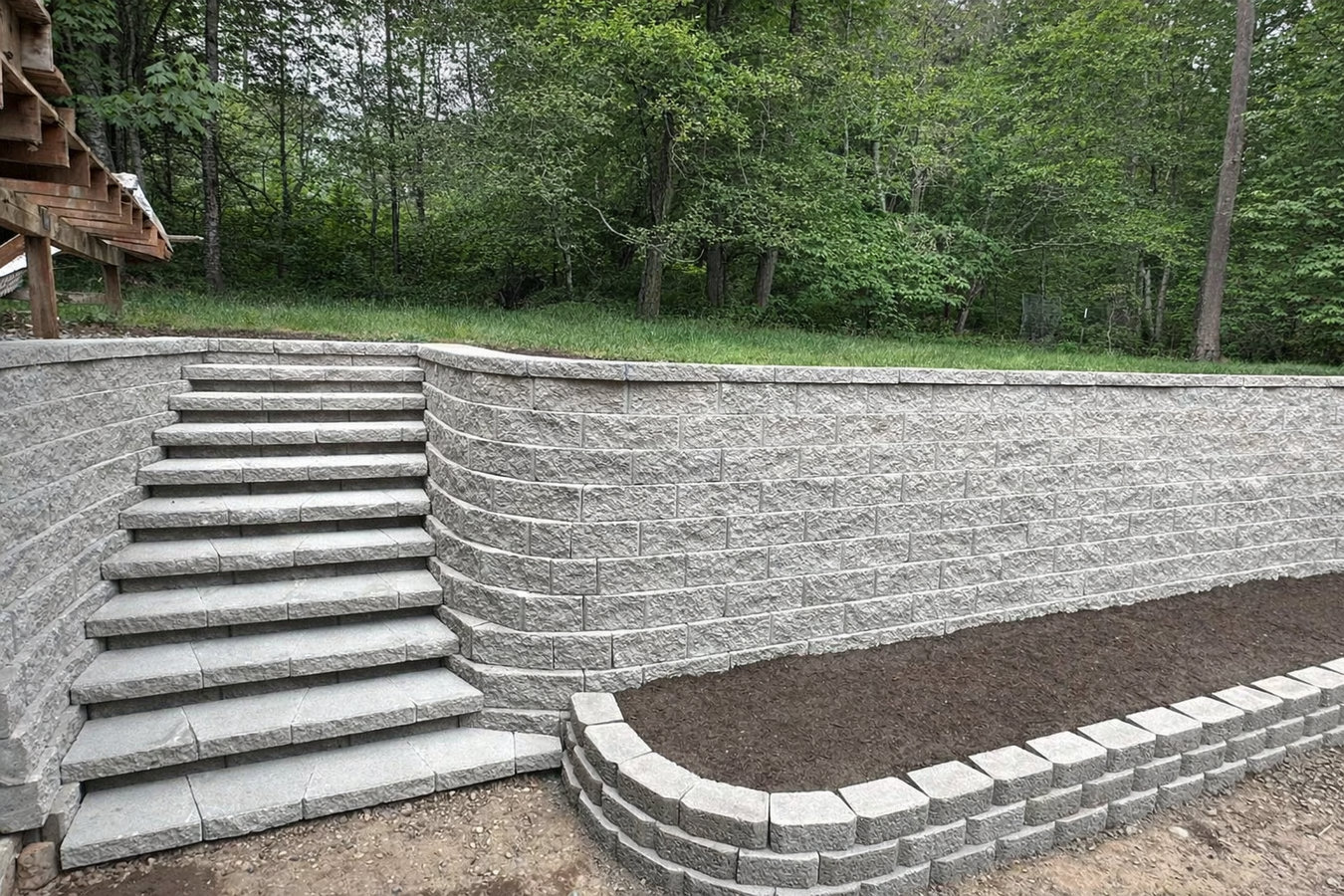
If your yard is washing away every spring or a slope is making part of your property unusable, a properly built retaining wall solves both problems and creates usable outdoor space at the same time.
Retaining wall construction in West Des Moines means building a structural wall that holds back soil on a slope, with proper drainage installed behind it so water pressure does not push it forward. Most straightforward residential walls take one to three days to complete, depending on the length, height, and material.
A lot of homeowners in West Des Moines come to us because a slope is causing erosion damage, directing water toward the house, or just making part of the yard too steep to use. The right wall fixes all of that and turns an unstable hillside into level, usable outdoor space. If you are also dealing with damage to an existing masonry structure, we handle masonry restoration on the same project or separately.
If you notice bare patches, ruts, or small piles of dirt at the bottom of a slope after rain, your soil is moving. In West Des Moines, spring storms and snowmelt can accelerate this quickly - a minor erosion problem in April can become a significant one by June without action.
A retaining wall that is visibly tilting away from the slope it holds is under stress it was not designed to handle. This is common in older West Des Moines neighborhoods where walls were built before current drainage standards. A leaning wall needs attention before it fails entirely.
If standing water collects close to your house after a storm, a nearby slope may be directing runoff toward your foundation. A retaining wall combined with proper grading can redirect that water away from your home - a real concern in central Iowa's wet spring season.
Unretained slopes between different levels of a yard become unstable over time, especially in clay-heavy soil. If you see the edge of your lawn crumbling, grass dying along a slope, or soil encroaching on a paved surface, a retaining wall is the right long-term fix.
We build retaining walls from concrete blocks, natural stone, and poured concrete, depending on what the site needs and what look you are after. Every wall starts with excavating to the frost line, setting a level base, and building up the drainage layer behind the wall as each course goes in. Skipping the drainage - which some contractors do to save time - is the single most common cause of premature wall failure in this area.
We also rebuild walls that have been pushed out of place and repair those where drainage has failed but the structure itself can be saved. Retaining walls often work best as part of a larger project. Many homeowners pair a new wall with masonry restoration on adjacent structures, or add concrete block walls for property boundaries or garden beds on the newly leveled ground.
Best for homeowners with an actively eroding slope, water drainage problems, or a yard that needs leveling to become usable outdoor space.
Best for walls that are leaning, bowing, or have gaps between blocks - usually caused by drainage failure that needs to be corrected as part of the rebuild.
Best for walls where the structure is still sound but the drainage system behind it has failed, causing sections to shift or water to pool.
Two things make West Des Moines harder on retaining walls than most parts of the country: clay-heavy soil and a deep freeze-thaw cycle. Clay holds water rather than letting it drain away, which means the pressure building behind a wall after a heavy spring rain is far higher than in sandy or loamy regions. That is why the drainage layer behind the wall is not a nice-to-have here - it is the part that keeps the wall standing. At the same time, central Iowa's frost depth reaches roughly 42 inches in a cold winter, so a wall whose base is not buried below that line will slowly get pushed out of the ground over several seasons. We excavate to the correct depth on every job, regardless of what it does to the cost estimate.
West Des Moines has also grown quickly over the past two decades, and many newer neighborhoods were built on land that was graded during development without permanent retaining structures. Homeowners in Urbandale and Norwalk regularly contact us about slopes between neighboring yards or along driveways that were never properly stabilized. Iowa State University Extension publishes soil and drainage guidance specific to central Iowa conditions, which informs how we approach base depth and drainage design in this market.
We respond within one business day. No contractor can give you an honest price from a photo or a phone call - we come to your property to see the slope, the soil, and what is already there before quoting anything.
We walk the area, check drainage, look at the slope and any existing structures, and give you a written estimate that breaks out materials, labor, permit fees, and drainage. You know exactly what you are agreeing to before work starts.
If your wall needs a City of West Des Moines permit - required for walls above a certain height - we handle the application and coordinate the timeline. Permit review typically takes several business days to a couple of weeks.
We excavate to frost depth, set the base, build the wall course by course, and install the drainage layer as we go. Most residential walls take one to three days. If a permit was pulled, a city inspector signs off before we close out the job.
We come to your yard, assess the slope, and give you a written quote with no obligation to move forward.
(515) 706-9183Central Iowa's frost line runs roughly 42 inches deep in a hard winter. We always excavate to that depth before setting any base material. A wall with a shallow footing will be pushed out of the ground within a few seasons here - we have seen it on jobs we were called in to rebuild.
The drainage layer behind a retaining wall is what keeps water pressure from pushing it forward. We install gravel backfill and drainage provisions as each course goes up, not as an afterthought once the wall is done. In clay soil, that detail is what separates a 30-year wall from a 5-year one.
West Des Moines enforces its permit requirements for taller retaining walls, and we pull those permits ourselves. That means your project gets a city inspection and documented approval - protection for your investment and your ability to sell the home without surprises.
When you call about a leaning wall, we tell you honestly whether it can be repaired or needs to come down and be rebuilt. We have no financial incentive to push a full replacement when a drainage correction and reset will do the job - and we say so.
Building a retaining wall that holds for decades in this climate requires getting the base and drainage right, not just stacking blocks. Those fundamentals are where we put our time, and they are what make the difference between a wall you forget about and one you are replacing in five years.
Repair and restore existing masonry structures on your property, including walls and hardscaping that have deteriorated over time.
Learn MoreBuild property dividers, garden borders, and structural block walls on the level ground your retaining wall creates.
Learn MoreSpring contractors in the Des Moines area book up fast - reach out now before the schedule fills and erosion gets worse after the next heavy rain.